Common Ant Species
Some ant species live in colonies that are supported by a single queen while others are supported by multiple queens. Although there are hundreds of known species of ants, there are relatively few types of ants that we commonly see as pests.
Ants taking over your property? Learn about helpful ant prevention tips you can implement to keep them out.
Need a professional solution? Find out about the steps you can take to get rid of ants.
Argentine Ant
(Linepithema humile)

Appearance
- Workers about 1.6mm long.
- Light to dark brown in colour.
- Do not swarm.
- Bite – do not sting.
Lifecycle
- Worker ants produced in spring and increase in numbers up until autumn.
- Winged ants (reproductive Kings and Queens), produced in early spring, before the workers, mature within three months and mate soon afterwards.
- Argentine ants mate in their nest so no swarming is seen.
Habits
- Worker ants will follow food trails for long distances so nests are not easy to track.
- They prefer sweet foods but will also eat live and dead insects, meats, cereals and damaged fruit.
- Argentine ants drive out other ant species from an area.
Black House Ant
(Ochetellus)

Appearance
- Shiny and black.
- 2.5 - 3mm long.
Lifecycle
- Larva hatches out of the egg as a white grub which is narrower towards the head. They are fed by the adults.
- The larva pupates and appears creamy-white, looking similar to an adult. Sometimes they have a protective silk cocoon around them.
- The adult emerges with the three defined body sections: head, thorax and abdomen.
- The length of time between the egg stage and ants emerging as adults can take 6 weeks or more; it depends on a variety of factors such as the species of ant, the temperature and the availability of food.
- Fertilised eggs become female, unfertilised become males.
Habits
- These ants are regarded as a nuisance and scavenge in kitchens, garbage and also dog excrement, therefore potentially spreading diseases such as salmonella.
- 'Common Ants' include the intensely black 'Black House Ants', and they are attracted to sweets.
- The light yellowish brown 'Coastal Brown Ant' prefers to feed on meat products and grease.
- The most effective control measure is to find the colony and treat it.
Coastal Brown Ant
(Pheidole megacephala)
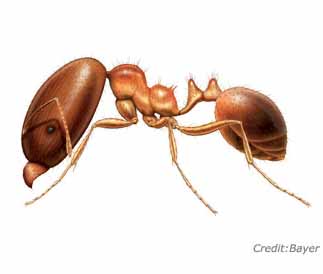
Appearance
- About 1.5-2.5mm long.
- Tend to be yellow brown to brown.
Lifecycle
- Eggs laid are small in size.
- Larvae are fed by the adults and after several moults the larvae pupate.
- Once adults, 3 different castes exist:
- - Workers are wingless and sterile that lives for approximately a year. Workers are the nest-builders, food suppliers, feed larvae, look after eggs and defend the nest.
- - Males are winged and exist to mate with females.
- - Females are also winged until after mating and are also the largest in size. Females become the reproductive queen of the colony and live for many years.
Habits
- Nest in soil and build along pathways around the house including gardens and walls.
- Dry areas for nesting.
- Will excavate leaving mounds along foot paths and other areas that are unsightly.
- Will attack foods around the property including meat, sweets, fruit and greasy foods.
Fire Ant
(Solenopsis spp)

Appearance
- Queens 15mm long.
- Workers 3-6mm long.
- Coppery–brown on the head and body, with a darker abdomen.
- Solenopsis has a very distinctive two–segment antennal club, which is most visible in the front view of the female reproductive ant.
Lifecycle
- After swarming from the nest and mating, the queen searches for a suitable spot to lay her eggs. Once found, she can lay up to 125 eggs in late Spring.
- Larvae hatch within 8 to 10 days, and the pupal stage lasts for 9 to 16 days.
- Larvae feed on secretions from the queen’s salivary glands and broken down wing muscles until the first worker ants emerge. After this first batch of larvae moult into workers the queen’s role returns to egg laying – she can lay up to 1500 per day. Worker ants continue with larval care, nest building and food foraging.
- Fertile males are produced later in the season.
Habits
- Foraging workers diet consists of dead animals, including insects, earthworms, and vertebrates. Workers also collect honeydew and forage for sweet food, proteins, and fats.
- Swarming characteristics – mating between queens and fertile males takes place on the wing mid to late Summer. Males perish after mating.
- Nest locations can be a mound of up to 40 cm or next to objects found on the ground, e.g. logs.
- If aggravated, these react aggressively and can inflict a painful sting, resulting in a pustule some 48 hours later.
- These ants are a major agricultural and urban pest, destroying crops and invading residential areas both outdoors and indoors.
Garden Ant
(Lasius niger)

Appearance
- Workers 4-5mm long.
- Queens 15mm long.
- Dark brown-black in colour.
- 1 small segment at waist point (pedicel).
- No sting present.
Life Cycle
- Queens overwinter in soil. Eggs are laid in late spring.
- Larvae hatch 3-4 weeks later.
- Larvae feed on secretions from the queen’s salivary glands until the first worker ants emerge.
- Worker ants continue with larval care, nest building and food foraging.
- Fertile males are produced later in the season.
Habits
- Foraging worker ants follow well–defined trails around food sources. Sweet foods are preferred but high protein foods will also be taken.
- Swarming characteristics – mating between queens and fertile males takes place on the wing mid to late summer. Males perish after mating.
- Nest locations – often outdoors in soil and below paving slabs on the sunny side of buildings.
- Nest locations can be identified by the presence of finely powdered soil around nest exit holes.
Pavement Ant
(Tetramorium caespitum)

Appearance
- Dark brown or blackish.
- 3mm long.
- 6 legs.
- 2 spines on the back.
- 2 nodes on petiole.
- Grooves on head and thorax.
- Thorax uneven with 1 pair of spines.
- 12-segmented antennae with 3-segmented club.
- Winged ants are often mistaken for termites.
Life Cycle
- Visible spring and summer.
- Have been known to emerge any time of the year in heated structures.
Habits
- Feeding - eat almost anything that humans eat, and also pet food.
- Visibility - seen entering houses looking for food, most often at night. May move through pipes and electrical wires.
- Nesting - in lawns or under stones, wood, or boards. Mounds built along sidewalks, baseboards, and near foundations in clusters.
- Colonies found near water.
Pharaoh’s Ant
(Monomorium pharaonis)
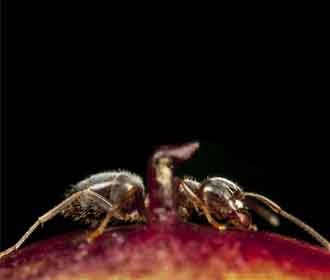
Appearance
- Workers 1.5-2mm long, yellow-brown with brown abdomen.
- Males 3mm long, black, winged.
- Queens 3.5-6mm long, dark red in colour with wings.
- Black eyes, 2 small segments at the pedicel.
Life Cycle
- Multi-queen colonies.
- Swarming can take place at any time of the year.
- Winged adults seldom fly so rarely seen. Wings are soon lost after mating.
Habits
- Well–defined trails are laid which are often associated with heating systems. Feeds indoors on high protein foods — meat, fats, blood, dead insects, etc.
- Swarming characteristics — new colonies are often formed through nests that have been disturbed e.g., as a result of insecticide spray treatments.
- Each queen produces up to 3,500 eggs in its lifetime.
- Nest locations — deep seated in cavities in heated buildings. Often found in hospitals. Associated with humid conditions. Colonies can range from a few dozen to 300,000 individuals.
Sugar Ant
(Camponotus app)

Appearance
- This species vary greatly in shape, size and colour.
- Range from 2.5 to 15 mm, and are some of the most often seen ants due to their size and often bright in colouring.
Lifecycle
- The ant’s life cycle passes through egg, larva, pupa and adult phases.
Habits
- Often nests in a variety of sites ranging from holes in wood to the roots of plants, twigs of trees and shrubs, between rocks or in the soil.
- They can also be seen during the day however, they are most active at night.
- They are unable to sting, but they do possess strong mandibles which can bite. In self-defense these ants are also able to spray acid from their abdomens to deter predators.
- They feed on dead and lives insects, household waste and are attracted by sweet food.
- They rarely enter houses.
Frequently asked questions Ant Species
-
What Ant species are common in Kenya?
Kenya’s diverse landscape is home to over 600 species of ants. The most common ones you'll encounter include:
- Argentine Ant (Linepithema humile): Light to dark brown ants that follow long food trails and aggressively drive out other insect species from their territory.
- Black House Ant (Ochetellus): Shiny black scavengers that frequent kitchens and waste areas, known for potentially spreading diseases like Salmonella.
- Coastal Brown Ant (Pheidole megacephala): Yellow-brown ants that build unsightly soil mounds along pathways and have distinct worker, male, and queen castes.
- Fire Ant (Solenopsis spp.): Coppery-brown ants that react aggressively when agitated, delivering a painful sting that results in a distinct pustule.
- Garden Ant (Lasius niger): Dark brown-black ants that nest in soil or under paving slabs, often identified by finely powdered soil around their nest holes.
- Pavement Ant (Tetramorium caespitum): Dark-colored ants that often enter buildings at night through pipes or electrical wires in search of human or pet food.
- Pharaoh’s Ant (Monomorium pharaonis): Tiny yellow-brown ants that nest deep in building cavities and "bud" into multiple new colonies if sprayed with standard insecticides.
- Sugar Ant (Camponotus spp.): Large, diverse ants that are most active at night and, while they don't sting, can deliver a strong bite and spray defensive acid.
-
Which Ant is the most poisonous in Kenya?
While many Kenyan ants have painful bites or stings, none are considered "poisonous" in a way that is lethal to healthy humans through venom alone. However, Safari Ants (Siafu) are the most dangerous due to their sheer numbers and aggression. They don't use venom; instead, they use powerful mandibles to lock onto skin. The Fire Ant is also notable for its "sting" which injects formic acid, causing a burning sensation and potential allergic reactions.
-
What smell do ants hate the most?
Ants rely on pheromone trails (scent paths) to communicate. They are naturally repelled by strong scents like peppermint, cinnamon, vinegar, and citrus.
-
What does having a lot of ants in your house mean?
A sudden influx of ants usually signals one of three things:
- A Reliable Food or Water Source: Even tiny crumbs or a slow-dripping pipe under the sink can support thousands of ants.
- Weather Changes: In Kenya, heavy rains often flood underground nests, forcing Safari Ants to seek higher, drier ground,often inside your home.
- A Nearby Nest: If you see "scout" ants (singular ants wandering around), it means a colony is nearby and looking to expand.
-
How do I destroy an ant colony?
To truly destroy a colony, you must eliminate the queen.
- The DIY Risk: Many people try pouring boiling water or ash on a nest. This usually only kills the top layer of ants. The survivors often sense the danger and move the queen deeper or split the colony into two (a process called "budding"), making your problem twice as bad.
- The Professional Solution: We use non-repellent liquid treatments and baits. The ants don't realize the substance is lethal, so they spread it throughout the entire underground network, ensuring total eradication.
-
How to Get Rid of Ants in Kenya?
1. Identify the Source: Follow the trail to see if they are coming from a wall crack or a nest in the garden.
2. Use Gels for Indoor Ants: For sugar ants, use Maxforce or Advion Ant Gel. They take the poison back to the queen.
3. Barrier Sprays: Use Bifenthrin or Deltamethrin based sprays around windows and door frames.
4. Sanitation: Ants in Kenya are mostly looking for water or sugar. Keep surfaces bone dry and store all food (including pet food) in airtight containers.